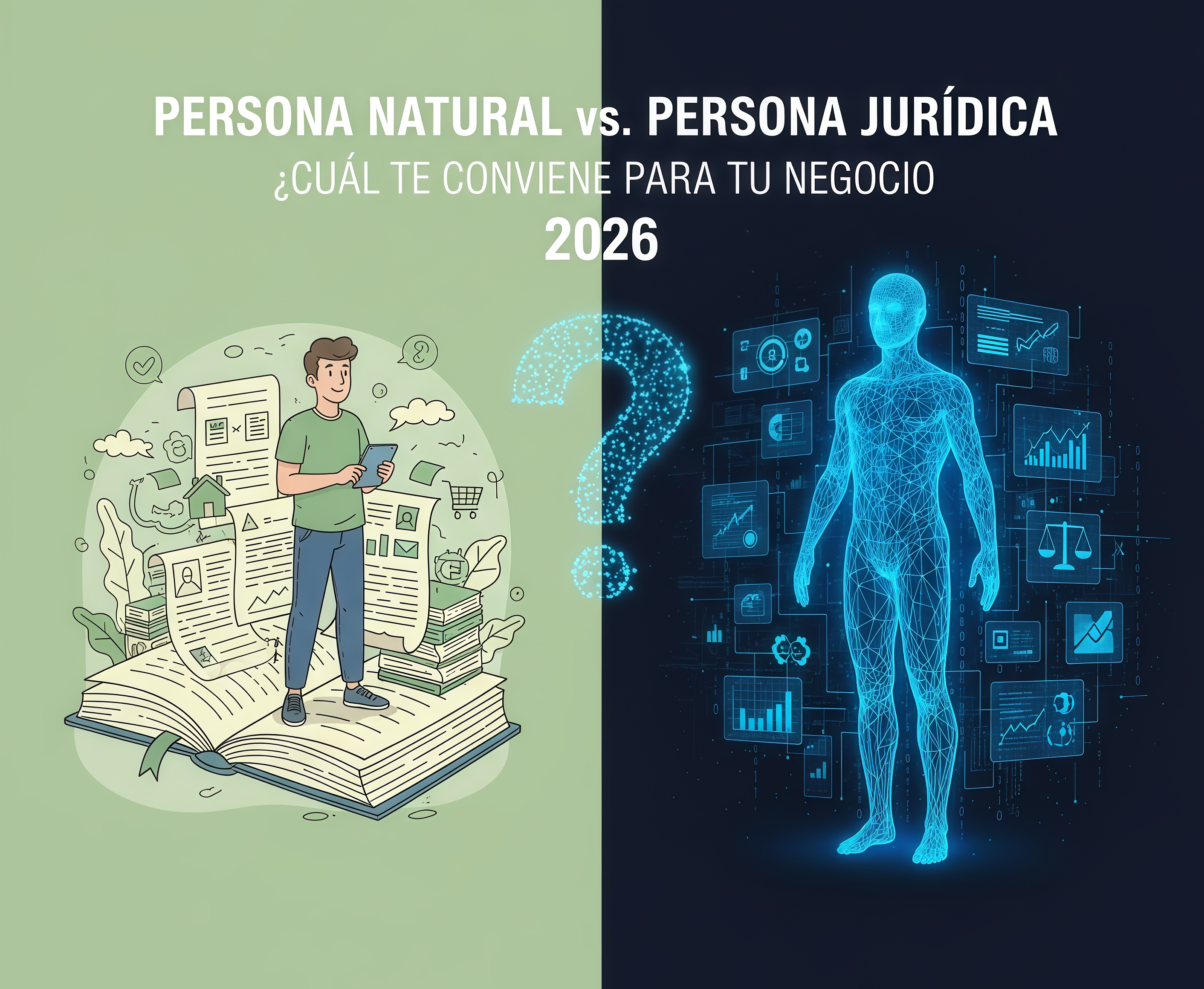
Natural Person vs. Legal Entity: Which is best for your business in 2026?
“Should I get RUC 10 or RUC 20?” This is the million-dollar question we receive daily at SacsMype.
Understanding the difference between Natural Person and Legal Entity is the most important decision you will make as an entrepreneur, because it defines:
- How you will protect your money.
- What risks you assume.
- How far your business can grow.
Here we explain it to you without lawyer speak.
What is a Natural Person with a Business? (RUC 10)
It is when you yourself, with your first and last name, carry out a commercial activity.
There is no separation between you and your business.
✅ Advantages
- Quick to obtain.
- Does not require partners.
- You do not need structured share capital.
- Ideal for independent trades such as:
- Plumber
- Freelance designer
- Independent consultant
- Technician
⚠️ The big risk: Unlimited Liability
Here is the key point.
If your business:
- Goes bankrupt
- Acquires a heavy debt
- Receives a fine from SUNAT
You will respond with your personal assets.
That means they could seize:
- Your house
- Your car
- Your personal savings accounts
You and your business are the same before the law.
What is a Legal Entity? (RUC 20)
It is creating a totally new entity, different from you.
It can be, for example:
- S.A.C.
- S.A.C.S.
- E.I.R.L.
The company has:
- Its own name
- Its own RUC
- Its own assets
- Its own legal liability
You are no longer the business. Now a separate company exists.
✅ The great benefit: Limited Liability
If the company goes bankrupt or has debts:
Only the capital contributed to the company is lost.
👉 Your house and your personal accounts remain protected.
That is the big difference.
📈 Growth and formality
Large companies, the State, and banks prefer to work with Legal Entities because:
- They have a formal structure.
- They generate greater trust.
- They allow access to business credits.
- They facilitate B2B contracts.
If you want to sell to large companies or participate in public bids, you will almost always need RUC 20.
🚀 The perfect match: The S.A.C.S.
Previously, creating a Legal Entity was expensive due to notary fees.
Today, thanks to Legislative Decree N° 1409, you can create a:
Simplified Closed Corporation (S.A.C.S.)
In a way that is:
- Cheaper
- Faster
- Using your Digital Signature
It is the perfect bridge to go from:
👉 Informal entrepreneur
to
👉 Corporate businessman
🤔 So… What suits you best?
It depends on your stage:
🟢 RUC 10 might work if:
- You are validating a small idea.
- You work alone.
- You do not handle large amounts.
- You do not have a commercial premise.
🔵 You need RUC 20 if:
- You have a commercial premise.
- You hire staff.
- You import merchandise.
- You handle credits.
- You want to sell to large companies (B2B).
- You want to protect your personal assets.
🎯 Conclusion
If your goal is to grow, protect your assets, and build a solid company in 2026, the Legal Entity is the natural path.
RUC 10 can be a start.
But RUC 20 is the next level.
If you want to know exactly which structure suits your case, at SacsMype we can guide you step by step.