Introduction
When you decide to formalize a business, one of the first steps is choosing the type of company you are going to incorporate. In Peru, there are several options: EIRL, SRL, SAC, SA, and the most recent, the SACS (Simplified Closed Corporation). Although all allow you to operate legally, each has particularities that can influence your decision, depending on your goals, resources, and business structure. In this article, we explain the main differences between the SACS and other forms of companies so you can choose the one that best suits your entrepreneurship.
How does the SACS differ from other legal forms?
Unlike other business denominations, the SACS is designed with a focus on simplicity and efficiency. For example, it does not require an in-person process before a notary, which represents significant savings in time and costs. Furthermore, it can be incorporated with a single shareholder or up to twenty, without the need for a board of directors or complex internal structures.
On the contrary, traditional forms such as the SAC, SRL, or SA require more paperwork: you need a public deed, the intervention of a notary, payment of registration fees, and, in some cases, more formal structures such as mandatory boards of directors and general meetings.
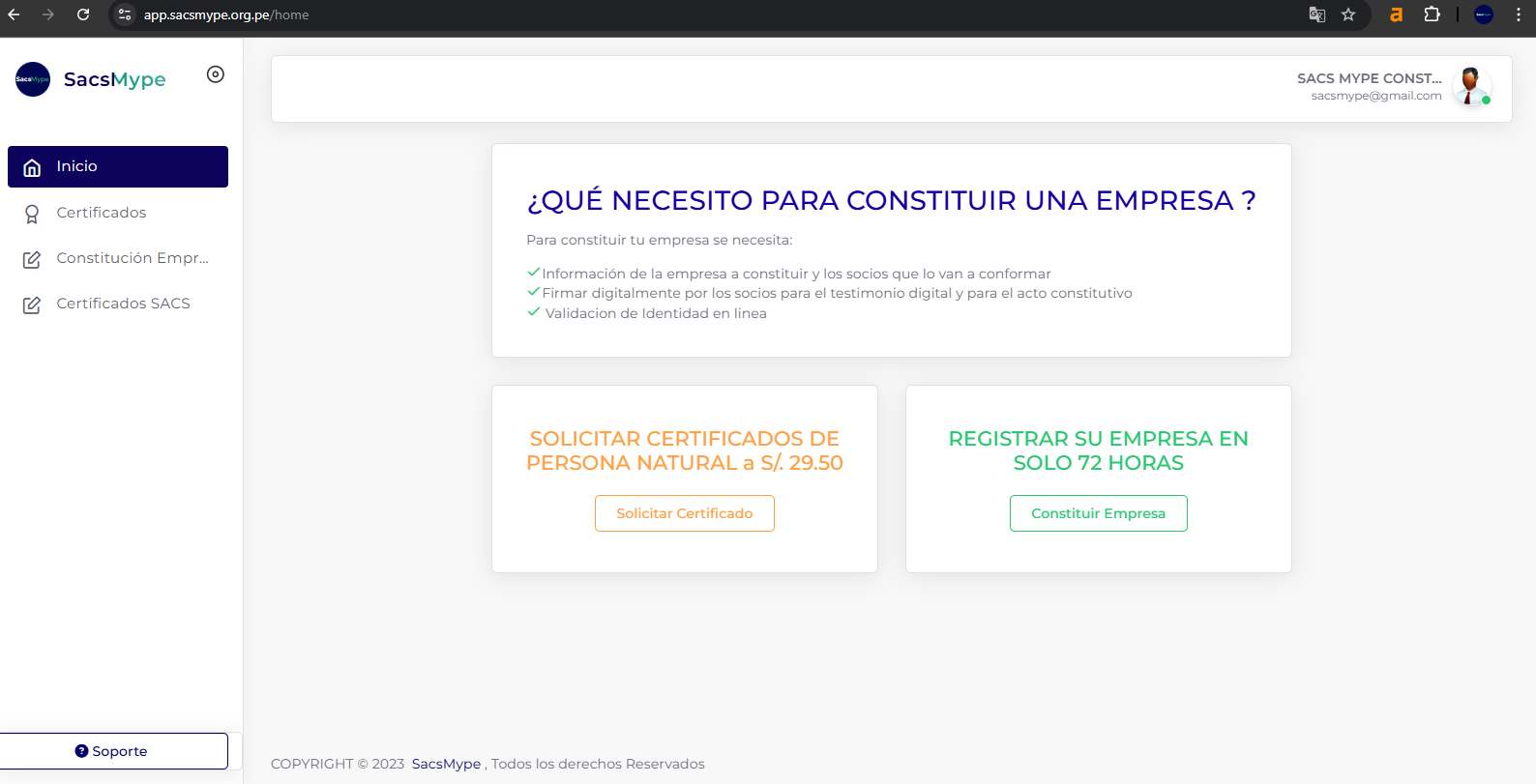
Another major difference is the ease of incorporation. While a SAC or SRL can take between one and two weeks (or more) to be fully operational, a SACS can be ready in less than 72 hours, provided the digital requirements (such as an electronic signature) are met.
What about the EIRL, SRL, SAC, and SA?
-
The EIRL (Individual Limited Liability Company) is designed for a single natural person, without partners. It is useful for those who start a business alone, but its incorporation is still in-person and more limited in terms of growth or the entry of new partners.
-
The SRL (Limited Liability Company) allows up to 20 partners, but it does not work with shares but with participations. Changing partners or transferring participation can be more complicated and less flexible than in the SACS.
-
The SAC (Closed Corporation) does work with shares, which facilitates the transfer of ownership, but its incorporation process is more traditional and expensive. In addition, although flexible, it remains more formal than a SACS in structure and internal governance.
-
The SA (Corporation) is the most robust and formal form. It is designed for large companies, with more demanding structures and the possibility of going public on the stock market. It is not a recommended option for small enterprises due to its complexity and associated costs.
When is it advisable to choose a SACS?
The SACS is ideal if:
-
You want to start your business quickly and without in-person procedures.
-
You are starting alone or with few partners.
-
You are looking to reduce legal and notary costs.
-
You do not need a complex business structure.
On the other hand, if your company is in a regulated sector, is looking for significant external financing, or plans to grow on a large scale with many partners or investors, a SAC or SA may be more suitable.
Conclusion
The arrival of the SACS has been a major step towards the democratization of formal entrepreneurship in the country. It allows thousands of people to make the leap from informality quickly, cheaply, and safely. However, it is not a universal solution. Each type of company has advantages and limitations, and the best decision will depend on your current needs and your future vision. If you are about to incorporate your company, inform yourself well, compare the options, and, if possible, consult with an accountant or legal specialist to make sure you make the best decision from the start.